Precision Health: The Ultimate Guide to At-Home Cortisol Testing
Unexplained fatigue, sleep disruption, or stubborn weight gain often signal a dysregulated stress response. To fix it, you have to measure it. This guide breaks down the science behind at-home cortisol testing and explains why we view mapping your diurnal rhythm via saliva as the gold standard for optimizing metabolic health.
Cortisol gets a bad rap. It isn’t the enemy. It’s fuel.
The problem arises when you fly blind. For years, elite optimization was limited by a lack of access to real-time physiological markers, forcing even the most dedicated athletes to rely on intuition rather than facts. At Vanguard Performance Labs, we believe that era is over. You cannot optimize what you do not measure.
The clinical landscape has shifted. You no longer need a doctor’s appointment just to obtain elite-grade insights. With high-accuracy at-home cortisol testing, you can now capture the precise bio-data necessary to fine-tune your protocols without ever leaving your living room. This capability effectively bridges the gap between guessing and knowing. That said, raw numbers are useless without context. To actually leverage this technology, you first need to recognize the subtle physiological signs – those quiet signals your body sends – that suggest your levels are drifting off-track.
But data is useless without context. To leverage this technology effectively, you first need to recognize the subtle physiological signs that suggest your levels are drifting off-track.
Decoding the Signals: When to Check Your Cortisol
It is easy to blame lingering fatigue on a lapse in discipline or perhaps a mere lack of sleep. We see this assumption constantly. Yet the root cause is often strictly biological. When the Hypothalamic-Pituitary-Adrenal (HPA) axis begins to dysregulate, the delicate feedback loop controlling your energy doesn’t just falter; it breaks down. The body responds by sending out specific physiological flares (warning signs that go beyond simple tiredness). These markers are our indication that we need to stop guessing and start testing.
But usually, the root cause is strictly biological.
At Vanguard Performance Labs, we analyze these signals by looking at your day in reverse.
Ideally, you should experience the Cortisol Awakening Response (CAR). This is a sharp, natural spike within thirty minutes of waking that actually energizes you. Compare that to waking up feeling like you’ve already run a marathon. Your heart races. Immediate anxiety sets in. If this sounds familiar, your AM levels are likely redlining.
Conversely, maybe you require three alarms and a double espresso just to reach baseline functionality. In that scenario, your morning cortisol has likely bottomed out.
Then there are the physical markers.
We often see clients confused by specific body composition changes that seem to defy their training volume. They are putting in the work, but the results aren’t matching up. Chronic high cortisol encourages visceral fat storage deep in the abdomen, pushing the abdominal wall outward. This “cortisol belly” feels firm. It protrudes noticeably, distinct from softer subcutaneous fat.
You might notice other weird symptoms of high cortisol, too. Sudden, unexpected salt cravings are common (electrolyte imbalances often follow HPA dysfunction). Dizziness upon standing is another red flag. Or perhaps a sudden, unexplained intolerance to bright lights.
Perhaps the most frustrating state for the high-performing individual is the “wired but tired” phenomenon.
You drag through the day, fighting heavy eyelids and distinct brain fog. Then you hit the pillow. Wide awake. This physiological contradiction often points to an inverted cortisol curve. Your levels are likely bottoming out in the morning when you need drive, only to spike at night when you most need recovery. We view identifying these metabolic patterns as the prerequisite for optimization.
Identifying these metabolic patterns is the first step toward optimization.
That said, feeling “off” isn’t a metric we can actually track. To build a precise protocol, we need to capture these hormonal fluctuations with clinical accuracy. This raises a critical question: which collection method actually delivers the data you need?
Methodology Matters: Saliva vs. Blood vs. Urine
Not all biological samples tell the same story.
When clients ask us, “Can I check my cortisol levels at home?” The answer is a resounding yes, but the medium you choose dictates the utility of the data we get back. In a clinical setting, your doctor might default to a serum (blood) draw. While standard, this method presents a significant variable for performance analysis: it measures total cortisol.
Total cortisol includes the hormone bound to proteins like cortisol-binding globulin (CBG).
Bound hormones are essentially in storage. They are biologically inactive.
That is why our protocols at Vanguard Performance Labs prioritize free cortisol. This is the bioavailable fraction. Unbound. Ready to execute. Since it isn’t locked in storage, this cortisol is circulating in your system and interacting with receptors to modulate inflammation, energy mobilization, and cognitive function. Saliva testing is crucial here because it captures that active fraction. It gives us a precision view of what your physiology is actually experiencing in real-time.
There is also the “Heisenberg certainty” of blood draws to consider.
Venipuncture – the act of getting stuck with a needle – is an acute physical stressor. If you are trying to figure out how to check to see if you have high cortisol, introducing a pain response seconds before collection can artificially spike your levels. It corrupts the baseline.
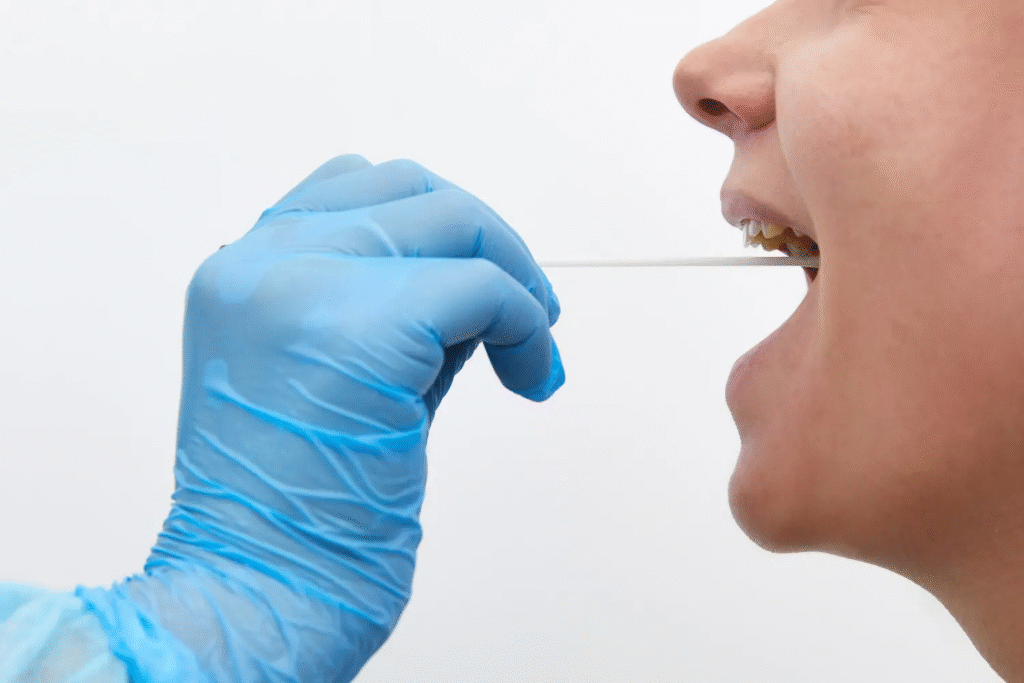
Saliva collection is passive. You simply chew on a cotton swab or spit into a tube. No stress response. No skewed data.
You will find quite a few practitioners who utilize urine testing, often strictly looking at dried samples. This methodology measures metabolites. It is excellent for calculating the total volume of cortisol your body produces over a 24-hour window, but it fails to capture the rhythm (which is what matters for distinct physiological profiling). Think of it like looking at a fuel gauge without knowing how fast the car was driving at any specific moment. We can see that you produced cortisol. We just cannot pinpoint when it was released.
For the precision required to optimize athletic and cognitive output, saliva is the superior diagnostic tool.
It forces us to address one final limitation, though. A single sample is just a snapshot.
Knowing your cortisol level at 8:00 AM provides a data point, but it tells us nothing about your recovery capacity or evening crash. A static number is useless for dynamic optimization.
To build a protocol that works, we have to look at the slope of the curve.
The Science of Timing: The Diurnal Cortisol Curve
Your hormonal system doesn’t operate on a static drip feed. It functions in waves.
To truly understand your metabolic profile, we have to map the specific rhythm of these fluctuations across a full twenty-four-hour window. This biological pattern is what we call the diurnal curve. For the high-functioning individual, a flat line is never the objective; we want to see a dynamic, responsive slope that mirrors your activity demands.
The cycle begins the precise moment you wake up. Scientists call this initial phase the Cortisol Awakening Response (CAR). During that pivotal first hour of consciousness, your brain actively signals the adrenal glands to flood the system with energy. Think of this simply as your physiological ignition switch.
A sharp, distinct rise here indicates a system primed for peak performance (your green light for high-output training). A blunted response, however, often correlates with burnout or chronic fatigue.
This context is precisely why we reject single-point testing for cortisol profiling.
A solitary blood draw at 9:00 AM provides a snapshot without a story. It tells us almost nothing about your recovery capacity. You might show a perfectly normal reading in the morning. But if that level fails to drop significantly by bedtime? Your recovery metrics will suffer regardless of your training intensity.
We simply need the full narrative. Standard comprehensive cortisol tests require multiple data points. That is why our team at Vanguard Performance Labs relies on a four-point collection protocol – morning, noon, evening, and night – to capture the complete circadian rhythm rather than a static moment. We are looking for a precise trajectory here. Your levels should be highest upon waking, drop precipitously by noon, taper gently through the evening, and hit their absolute floor right before sleep.
With this four-point visibility, we can isolate exactly where your axis is dysregulated. Take the “tired and wired” executive profile. They might look physiologically optimized in the morning but fail to taper at night, creating a sleep deficit that ruins the next day’s performance. Then there is the overtrained athlete. We often see a flattened curve all day long with this demographic. Evidence of systemic exhaustion.
But capturing this delicate rhythm requires strict adherence to protocol. Even the most advanced analysis fails if the sample itself is compromised by external variables.
Accuracy, Preparation, and Interfering Factors
The variable in this equation usually isn’t science. It’s you.
Cortisol refuses to sit still. As a volatile hormone, it reacts aggressively to immediate stressors, meaning your actions in the hours leading up to sample collection determine whether the data is valid or useless. If you down a double espresso before spitting into the tube, you aren’t measuring your baseline adrenal function (the goal). You are simply measuring your body’s reaction to caffeine.
To ensure data integrity, we enforce a strict pre-test protocol.
This “washout period” is non-negotiable for anyone serious about accurate metabolic profiling. For the 12 to 24 hours prior to testing, specific triggers must be avoided:
- Vigorous exercise. A heavy deadlift session or high-intensity interval training spikes cortisol acutely.
- Stimulants. Factors like caffeine and nicotine artificially elevate adrenal output.
- Gum and brushing. This sounds minor, but even slight friction can cause micro-bleeds in the gums. Blood contamination introduces protein-bound cortisol into the sample, which skews the “free” cortisol reading we need to capture.
- Acidic or blood-thinning foods. Certain inputs can alter saliva pH or induce micro-abrasions.
When these protocols are followed, the reliability of these diagnostics is high. Exceptionally high.
The kits we recommend utilize CLIA-certified laboratories – the exact same facilities used by hospitals and primary care physicians. By employing Liquid Chromatography-Mass Spectrometry (LC-MS/MS), these labs detect hormone levels with clinical precision. The technology is identical.
The difference lies in the objective.
Traditional medicine uses these numbers to diagnose pathology. Doctors generally look for levels that are catastrophically high or low, screening for conditions like Addison’s disease or Cushing’s syndrome.
At Vanguard Performance Labs, our lens is different.
We aren’t looking for disease. We are looking for optimization. A result might fall within the “normal” clinical reference range yet still indicate a dysregulated rhythm that hampers individual athletic recovery or cognitive focus. We analyze the curve for sub-clinical deviations. These are the subtle shifts that separate good health from peak performance.
Once you trust the data, the next hurdle is often practical implementation.
Logistics: Cost, Turnaround, and Insurance
Now, regarding insurance.
We often get asked if major carriers cover these kits. The direct answer is usually no. Because these are wellness tools rather than diagnostic procedures ordered by a primary care physician for a specific pathology, they fall outside standard coverage. However, most reputable functional testing companies accept HSA (Health Savings Account) and FSA (Flexible Spending Account) payments.
Using pre-tax dollars effectively discounts the protocol by your marginal tax rate.
We engineered the collection process for minimal friction. You simply collect the sample – usually saliva – seal it in the provided biohazard bag, and drop it in a prepaid mailer.
Emerging biosensor technology aims to shrink this window to minutes, but for now, the mail-in model remains the gold standard for accuracy.
Once that digital dashboard lights up with your cortisol curve, the logistics end and the real work begins.
Data to Action: Optimizing Your Stress Response
Raw data holds zero value without context. It is just noise.
We call this critical next step the translation phase.
If your results show a curve that stays stubbornly elevated – refusing to taper off in the evening – we pivot the protocol immediately toward downregulation. This adjustment is urgent. In practice, this might mean shifting High-Intensity Interval Training to the morning hours or integrating specific adaptogens like ashwagandha. Other times, the obstruction is environmental. We may need to radically overhaul your pre-sleep surroundings to forcefully lower sympathetic nervous system activation.
A flatline demands a different tactical approach. When cortisol is chronically suppressed or the diurnal rhythm is inverted, the operational goal shifts entirely toward restoration. We often prioritize maximizing early morning light exposure and adjusting macronutrient timing to gently coax the HPA axis back into a healthy cadence. That said, keep this in mind. An at-home cortisol test is a reconnaissance tool, but it is not a diagnosis.
While these insights are powerful for bio-hacking your daily routine, we strongly recommend reviewing your physiological markers with a healthcare provider or a performance specialist. They possess the clinical background to distinguish between a temporary slump and a complex endocrine issue that requires medical intervention.
At Vanguard Performance Labs, we view this data as the blueprint for your next level. You aren’t just managing stress. You are engineering resilience.
That is the definition of true optimization.
Leave a Reply